Author: Yutong Huang, Vikranth Srivatsa, Alex Asch, and Yiying Zhang
TLDR: Agentic reinforcement learning (RL) trains browser and computer-use agents inside real workspaces, so every rollout carries a full running environment. Two costs dominate: memory for hundreds of concurrent environments, and slow tool calls that stall the synchronous batch. Yet those environments are mostly identical, and the same tool calls recur across training iterations. We built BunshinRL, an agentic RL rollout system that exploits this with memory sharing, tool-prefix caching, and speculative tool execution, all built on BunshinFork, a live copy-on-write fork of a whole container workspace. BunshinRL reduces peak memory by up to 43%, total memory consumption by up to 51%, and end-to-end rollout latency by 23%, while reaching the same reward. Check out our full paper on arxiv.
Agentic RL Rollouts Are Bound by Their Environments
In agentic RL, the policy reasons, emits a tool call (click a button, run a command, load a page), and waits for the environment to return an observation, over and over until the task ends. Every rollout therefore needs its own persistent, isolated workspace: for a computer-use agent, a browser, a display server, and desktop applications. This brings two costs that text-only RL never had:
- Memory. At about 4 GB per sandbox, a batch of 256 rollouts needs 1 TB of CPU memory, and GRPO multiplies this by sampling several trajectories per task.
- Tool latency. A tool call can take seconds to minutes. Synchronous RL waits for the slowest trajectory, so a few long tool chains set the pace of the whole training step.
The Opportunity: Rollouts Repeat Themselves
First, environments in a batch are largely the same: same libraries, same applications, same task data. Trajectories in one GRPO group start from the same task and diverge only gradually.
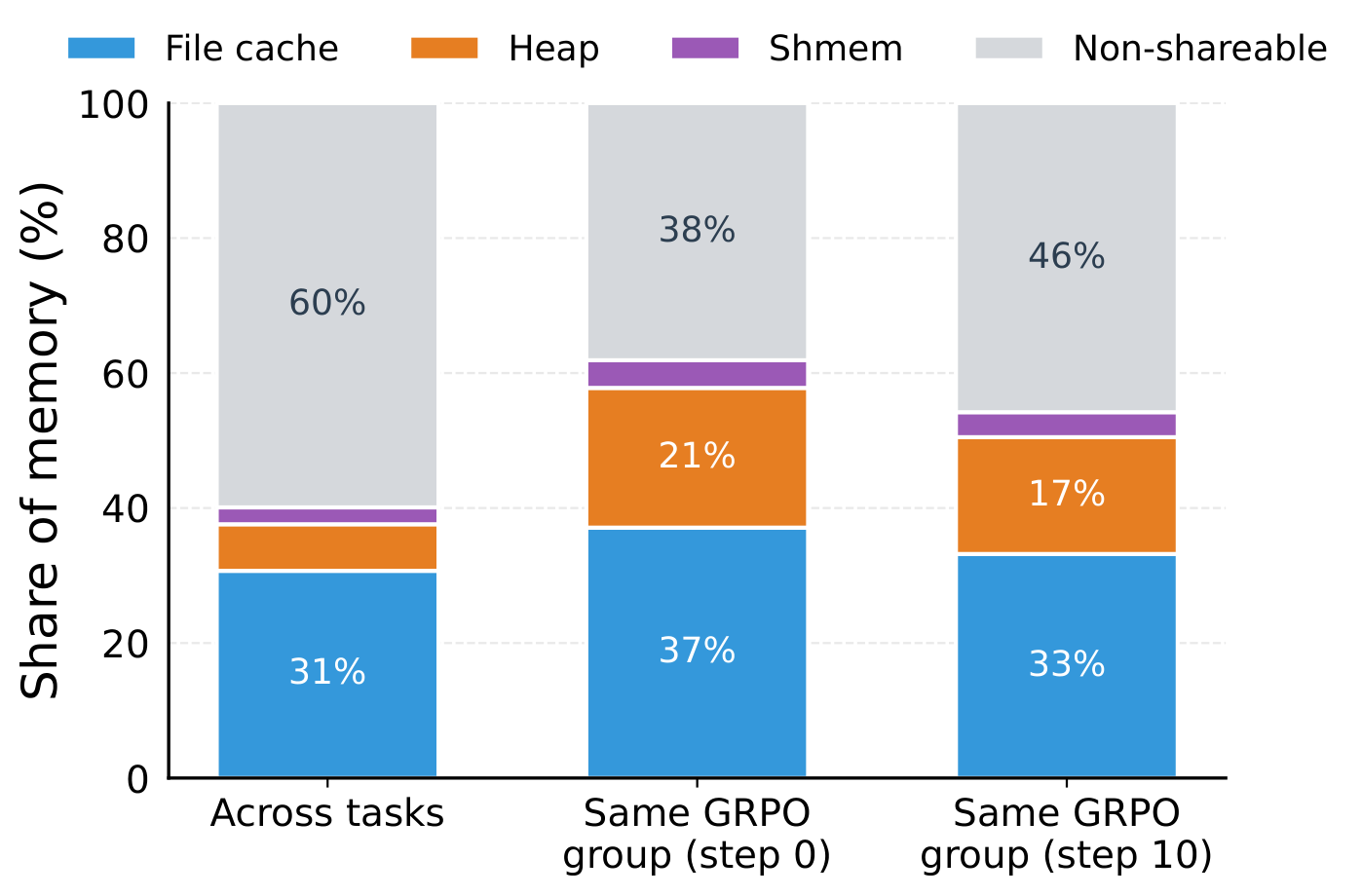
Share of an environment's memory that is identical in another environment. Within a GRPO group, over half stays shareable after ten steps.
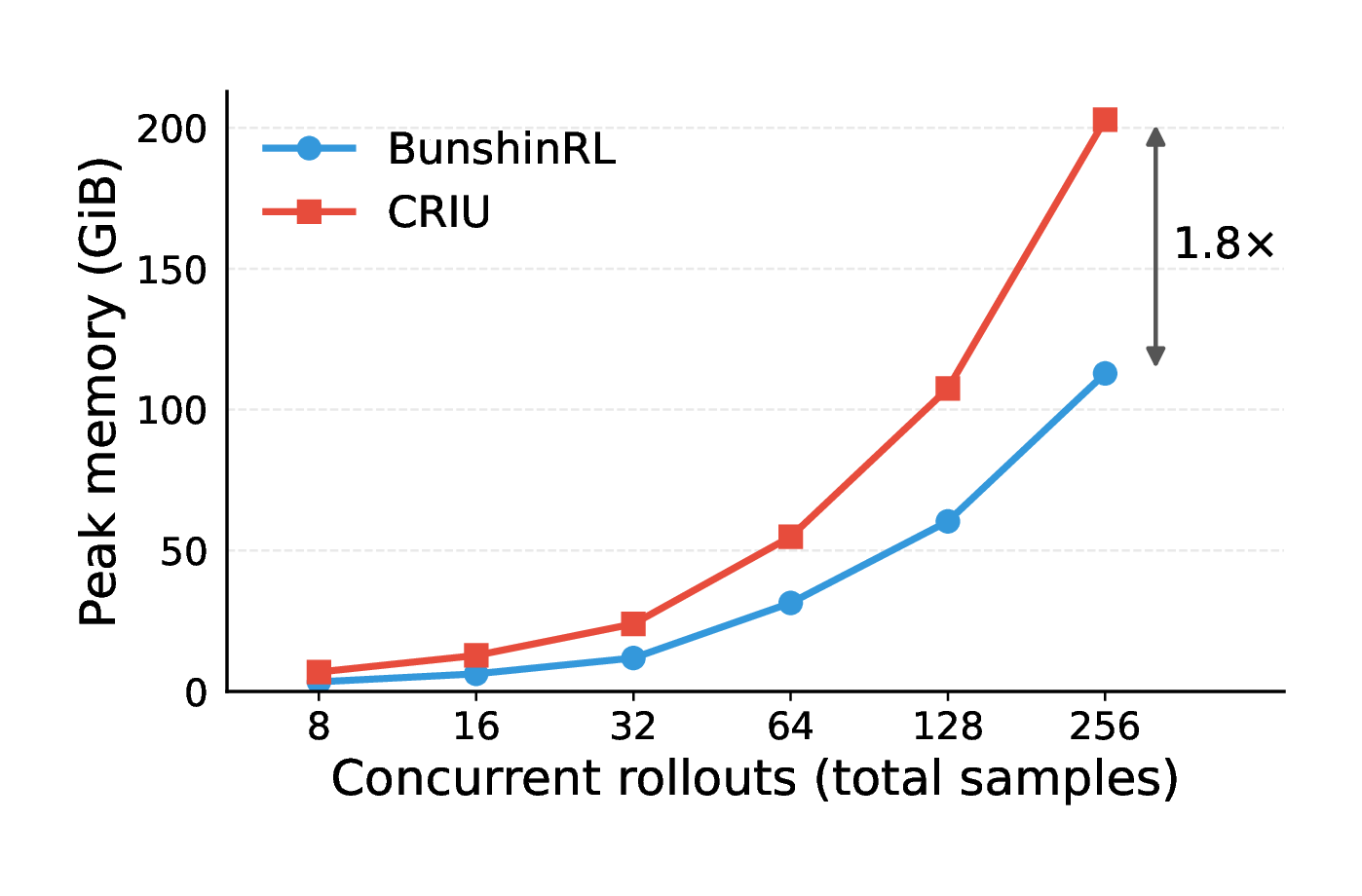
Peak memory as concurrent rollouts grow. Private copies (CRIU) need 1.8x the memory of sharing unchanged pages at 256 rollouts.
Much of that shareable memory is heap and shared memory built up at runtime, which container image layers cannot deduplicate. Keep one physical copy and allocate private pages only where an environment diverges, and memory scales with what trajectories change, not with how many there are.
Second, tool calls repeat. Training revisits the same tasks every epoch, so trajectories often reissue the same opening calls, and recurring calls make the next one predictable. A matching prefix can be skipped; a predicted call can run early, hidden behind the model’s reasoning. The catch is that a tool call also leaves behind modified files, running processes, and in-memory application state, so both reuse and speculation require forking the whole workspace.
BunshinRL: Three Techniques, One Primitive
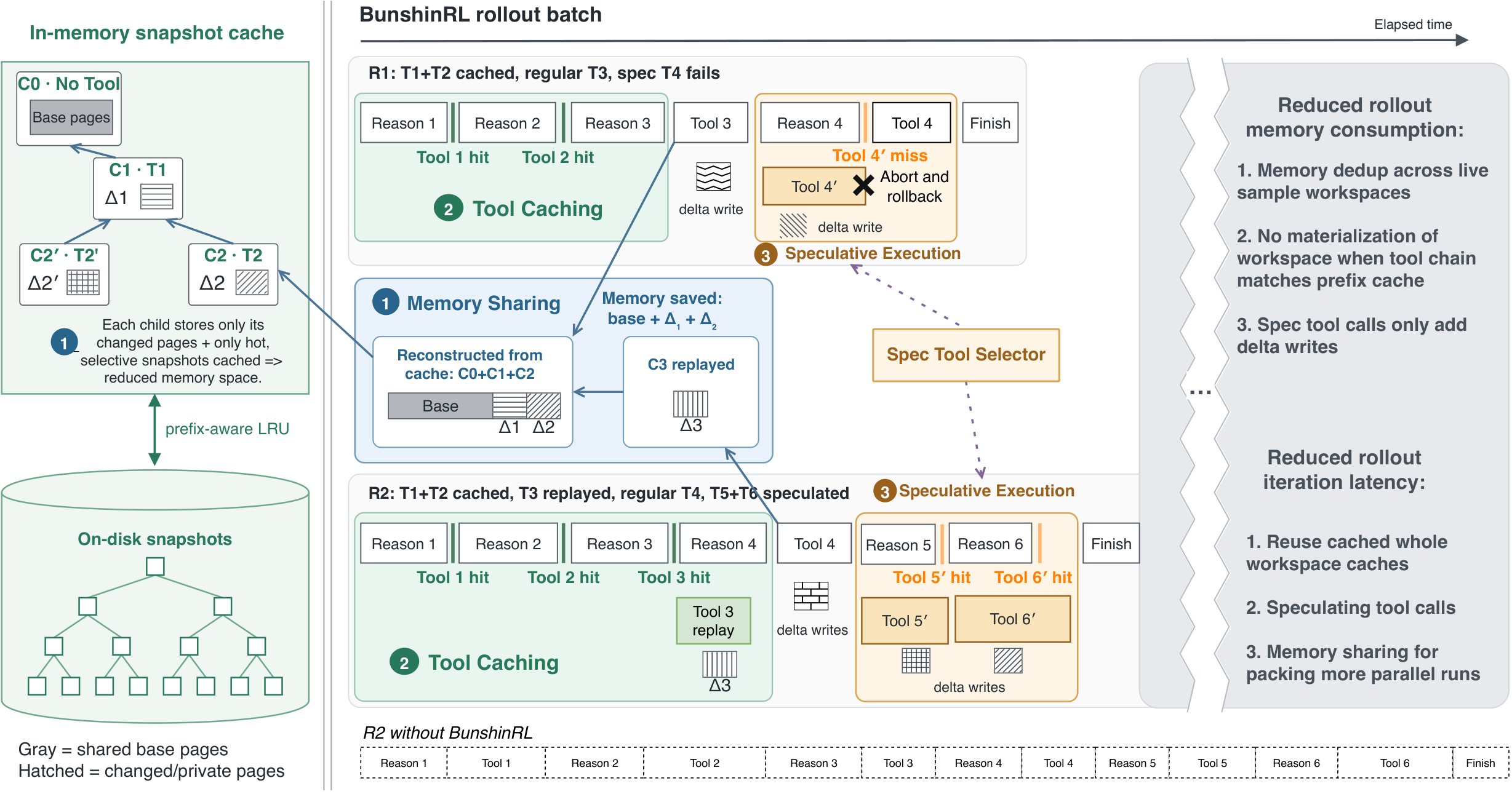
BunshinRL in one rollout step. Left: the prefix tree of workspace snapshots, stored as deltas on disk with hot snapshots in memory. Right: R1 skips cached Tools 1 and 2, then rolls back a failed speculation of Tool 4; R2 skips Tools 1 to 3 and successfully speculates Tools 5 and 6.
Memory sharing. Rollouts for a task fork one initialized workspace copy-on-write (CoW): all branches map the same physical pages, and a branch gets a private page only when it writes. Batch memory becomes the common state plus each sample’s changes.
Tool-prefix caching. Past tool calls form a prefix tree rooted at the initial workspace, where each node holds the workspace state after a call. A sample walks the tree as its policy generates calls, skipping every match, and forks a writable branch at the first miss. Nodes store only the pages their call changed, hot snapshots stay in memory, and uncached prefixes are rebuilt by replaying calls from the nearest cached ancestor while the model reasons.
Speculative tool execution. A small classifier, the Spec Tool Selector, predicts a sample’s next tool calls from previously recorded ones. BunshinRL forks the workspace and runs them while the model is still reasoning. If the policy’s actual call matches, the speculative result is adopted; otherwise the branch is discarded and the real call runs from the pre-speculation snapshot. Speculation is reserved for the tail samples that decide when the batch finishes.
BunshinFork: Forking a Live Container
Checkpoint/restore tools like CRIU serialize a workspace to disk and rebuild a private copy, which is slow and duplicates every page. MicroVM sandboxes can share snapshot memory, but each runs its own guest kernel. BunshinFork forks containers, where the host kernel sees every page and can share them directly.
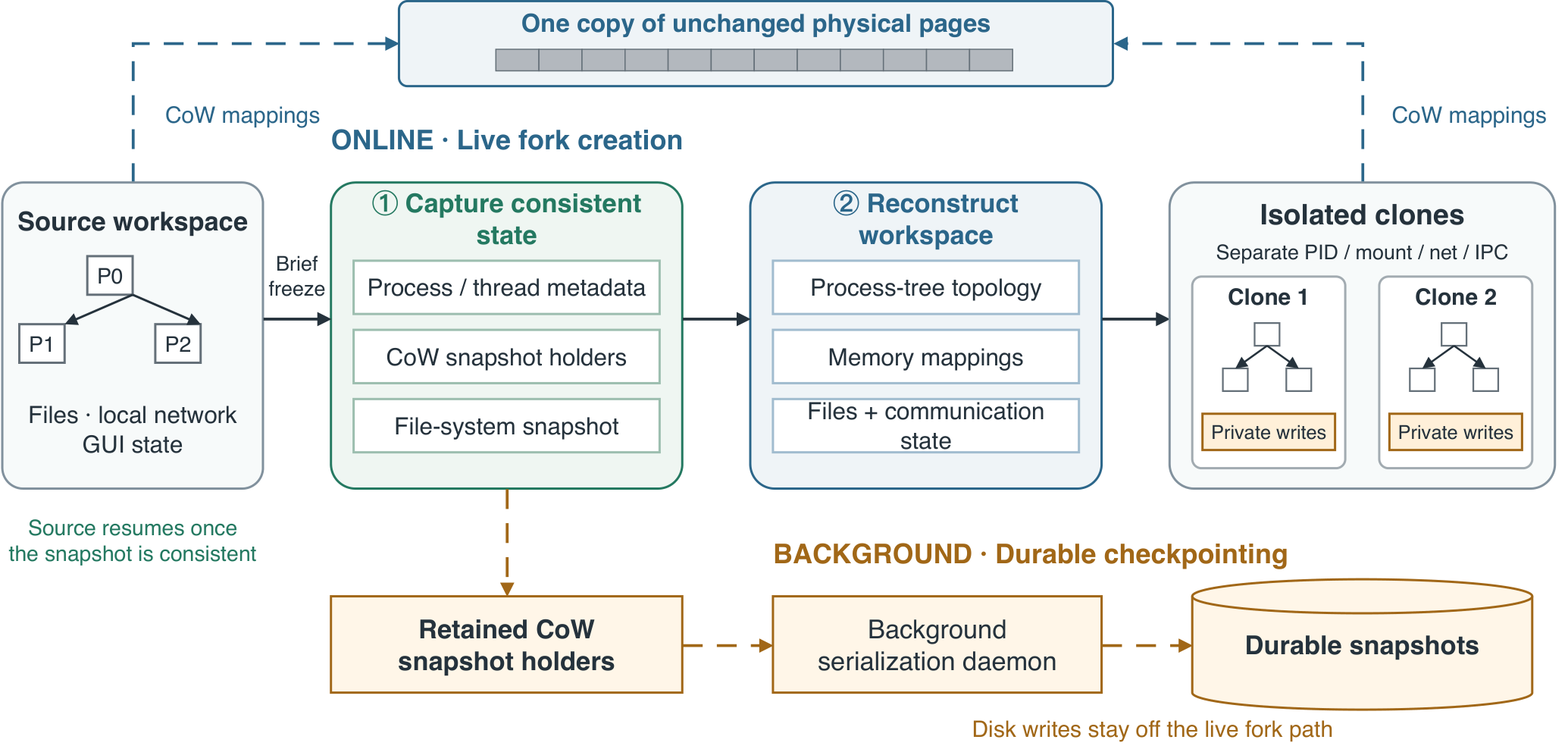
BunshinFork architecture. A brief freeze captures a consistent state; clones share unchanged pages copy-on-write, while durable checkpointing runs in the background.
Its key principle is to separate online fork creation from durable checkpointing. The source is frozen only long enough to record process metadata, set up CoW mappings, and snapshot the file system. No application memory is copied, and writing to disk happens in the background. Two mechanisms make the fork work:
- Processes. Plain
fork()makes each copy a child of its source, scrambling the tree. BunshinFork rebuilds the recorded topology inside a new container. - Memory. A kernel module extends CoW sharing across container boundaries, so clones share pages until they write.
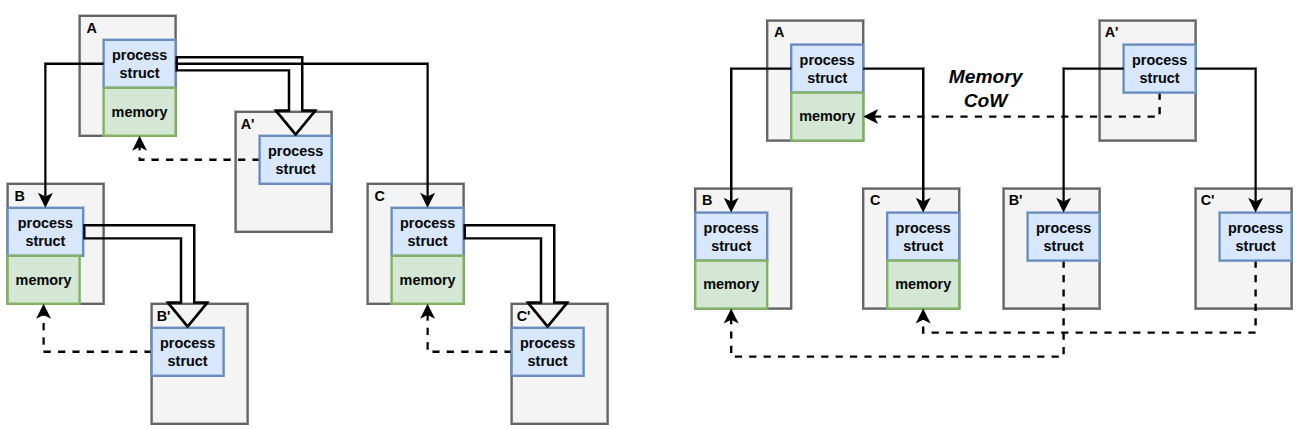
Linux fork() (left) makes one process a child of its source. BunshinFork (right)
rebuilds the whole process tree in a sibling container, sharing memory copy-on-write.
How Well Does It Work?
We train Qwen3-VL-8B with GRPO on OSWorld and the WebArena shopping site, and compare against CRIU, which restores each fork from disk with a private memory copy, and AgentENV, a Firecracker microVM sandbox built for Kimi K3 RL whose forks share snapshot memory.
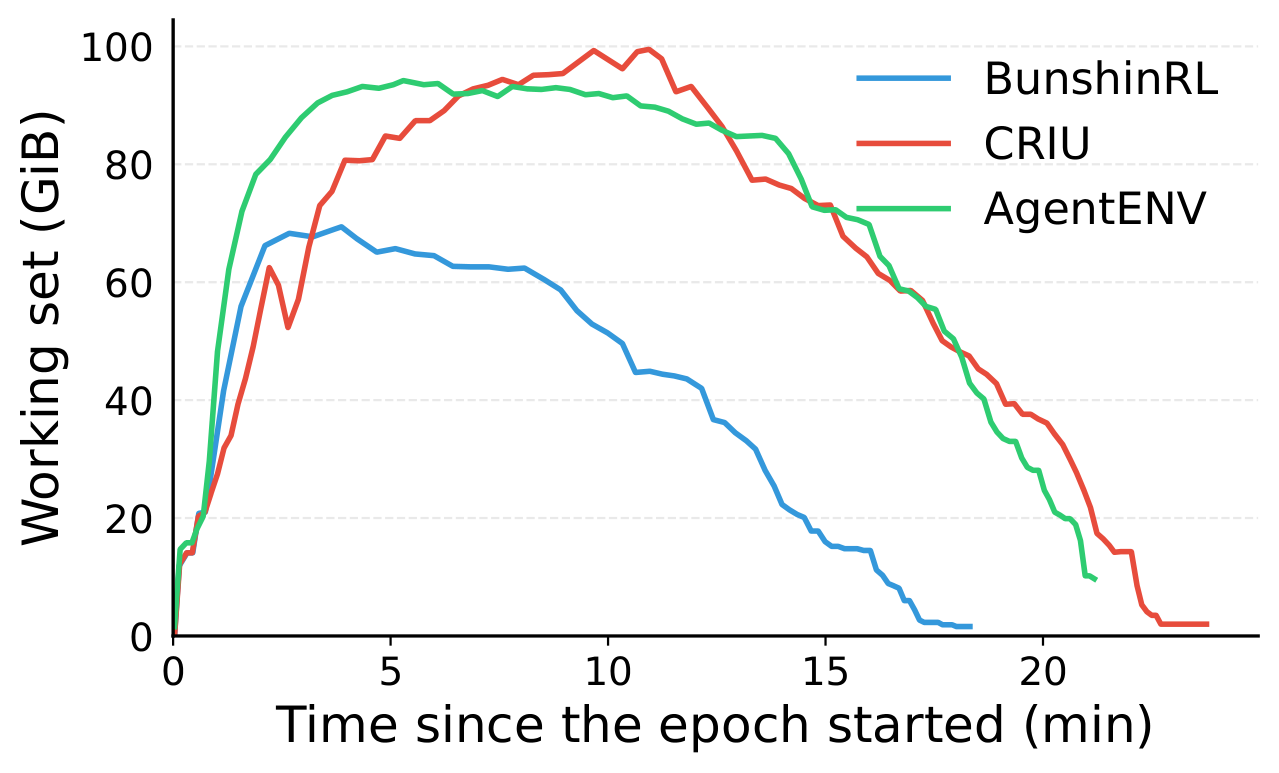
Working set over one OSWorld epoch.
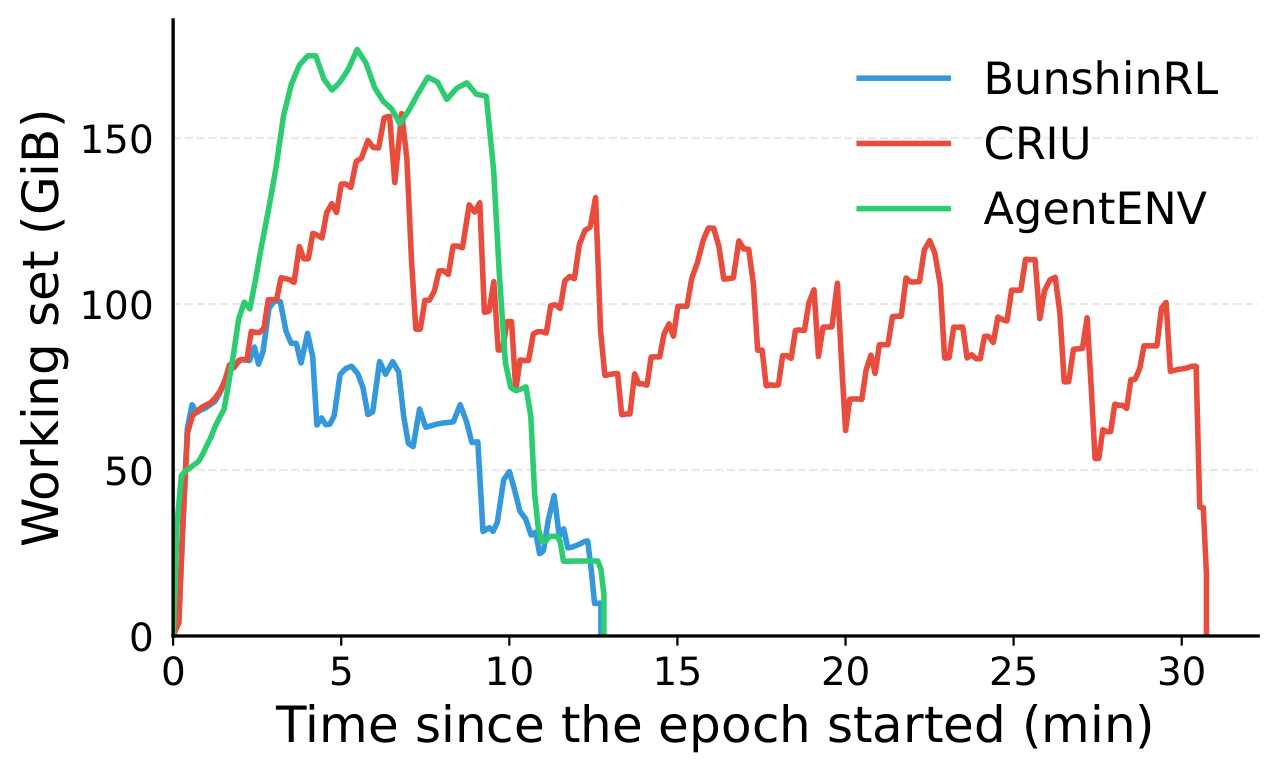
Working set over one WebArena epoch.
BunshinRL cuts peak memory by 30% vs. CRIU and 26% vs. AgentENV on OSWorld, and by 43% vs. AgentENV on WebArena. CRIU pays for a full environment per fork; AgentENV shares memory but carries a guest kernel and private page tables per microVM. Memory also turns into time: on WebArena, CRIU must shrink its batch to fit in 256 GB and takes 2.4x longer per epoch.
To isolate the latency techniques, we compare Base (memory sharing only), Spec (plus speculation), and Full (plus speculation and prefix caching) on OSWorld.
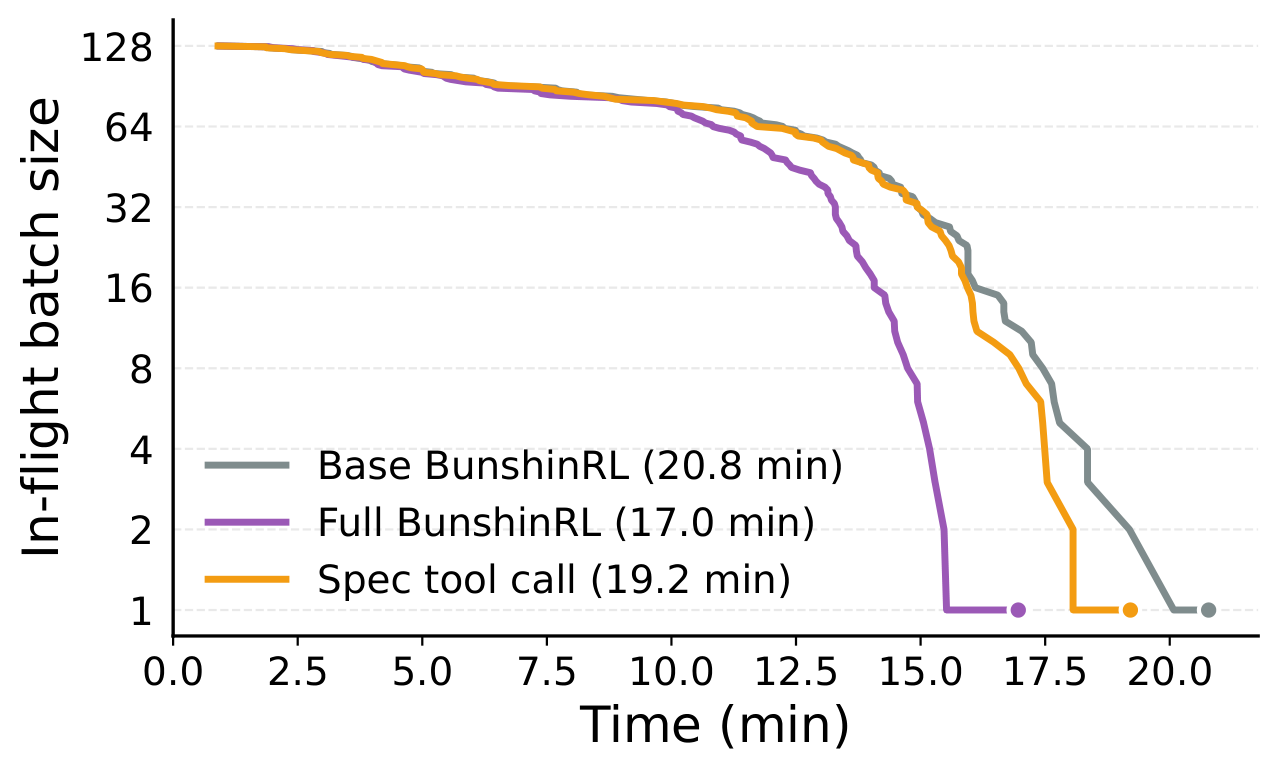
Rollouts still running over one OSWorld epoch.
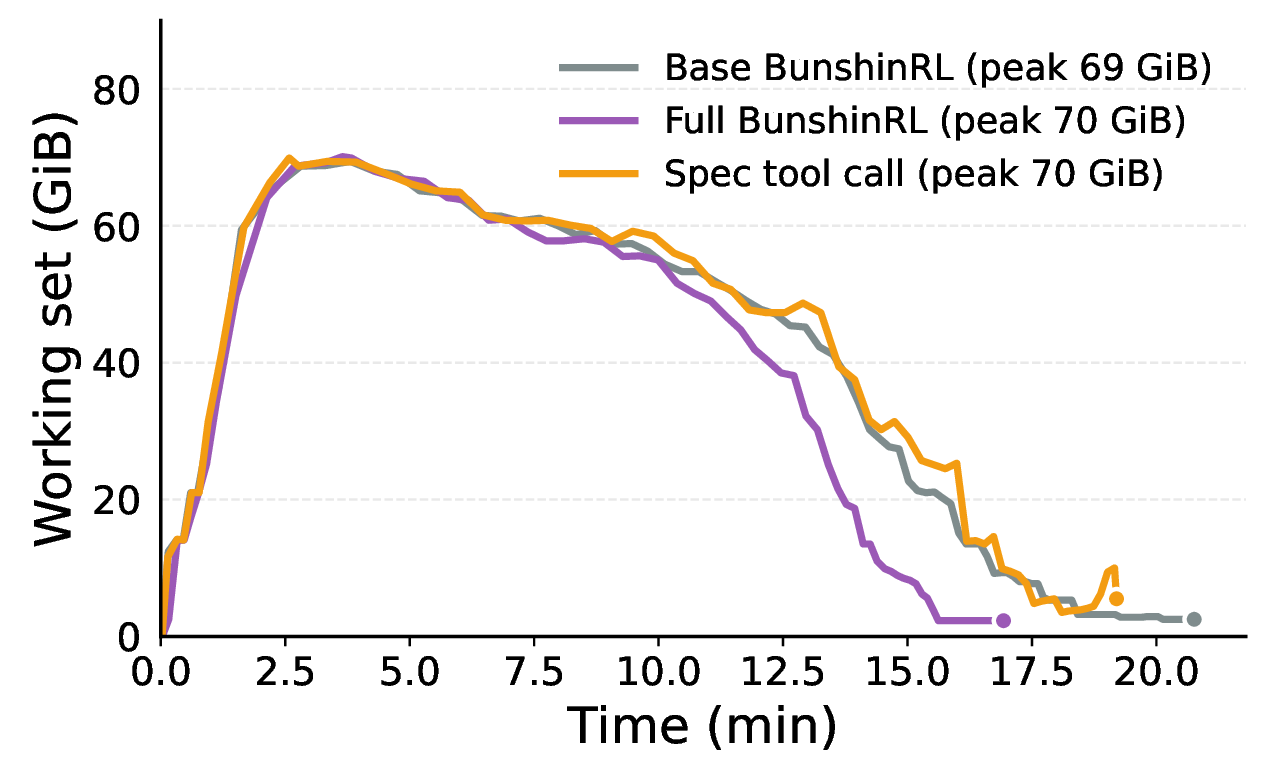
Working set over the same epoch.
Full finishes the epoch in 17.0 minutes vs. 20.8 for Base, with Spec at 19.2. Speculation mostly shortens the tail, while prefix caching skips matched calls outright and speeds up rollouts throughout. Because snapshots and speculative branches are CoW forks that pay only for pages they change, peak memory rises only from 69 to 70 GiB.
For fork microbenchmarks and more detailed results, check out our paper.
Our Vision
Agentic RL turns every training sample into a running computer. BunshinRL shows that the environments in a batch, and across training iterations, are overwhelmingly redundant, and that a cheap, live, whole-workspace fork is the right primitive to exploit it: sharing memory, reusing past work, and speculating ahead all become the same operation. The same fork applies beyond RL, to agent inference and other workloads that branch.